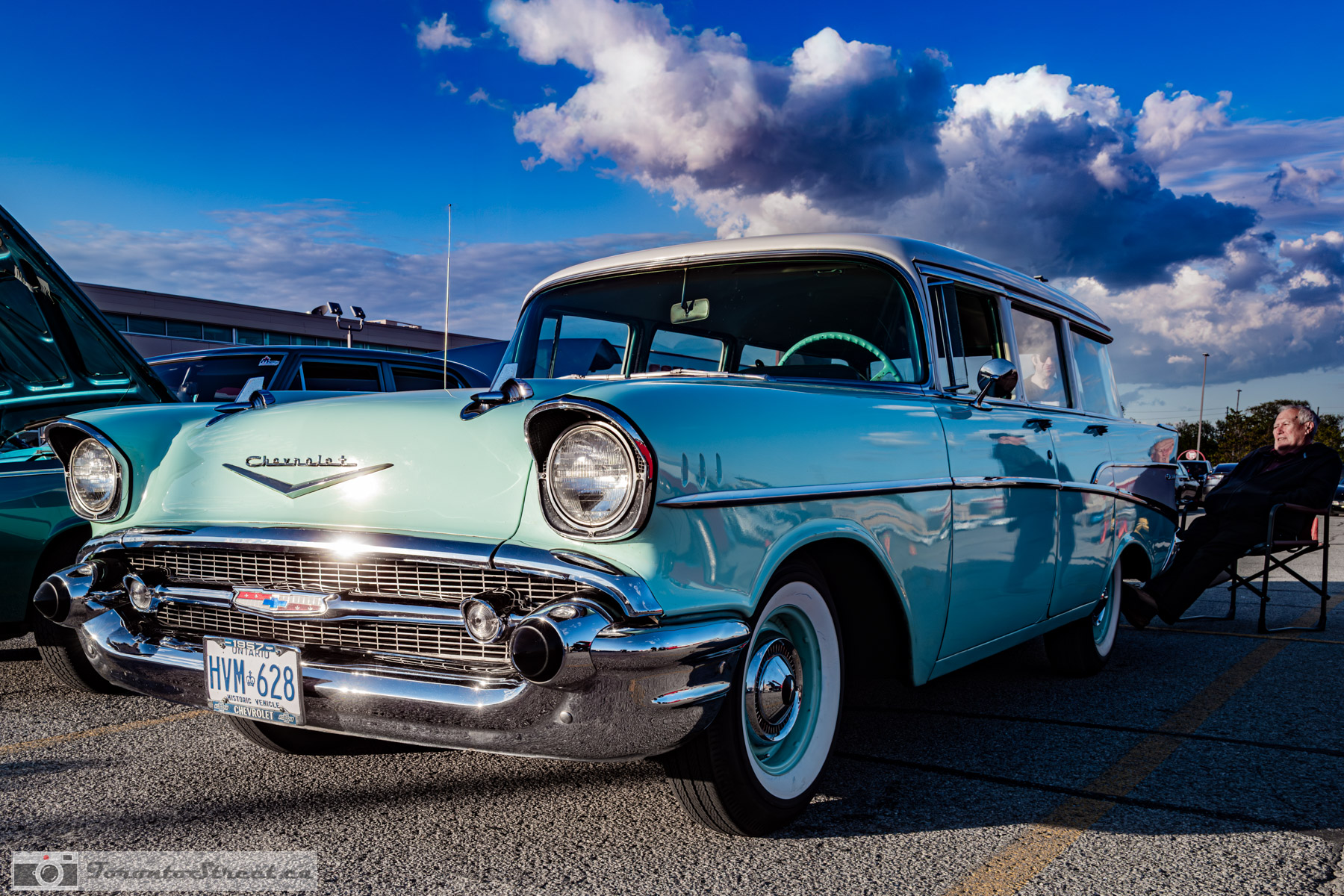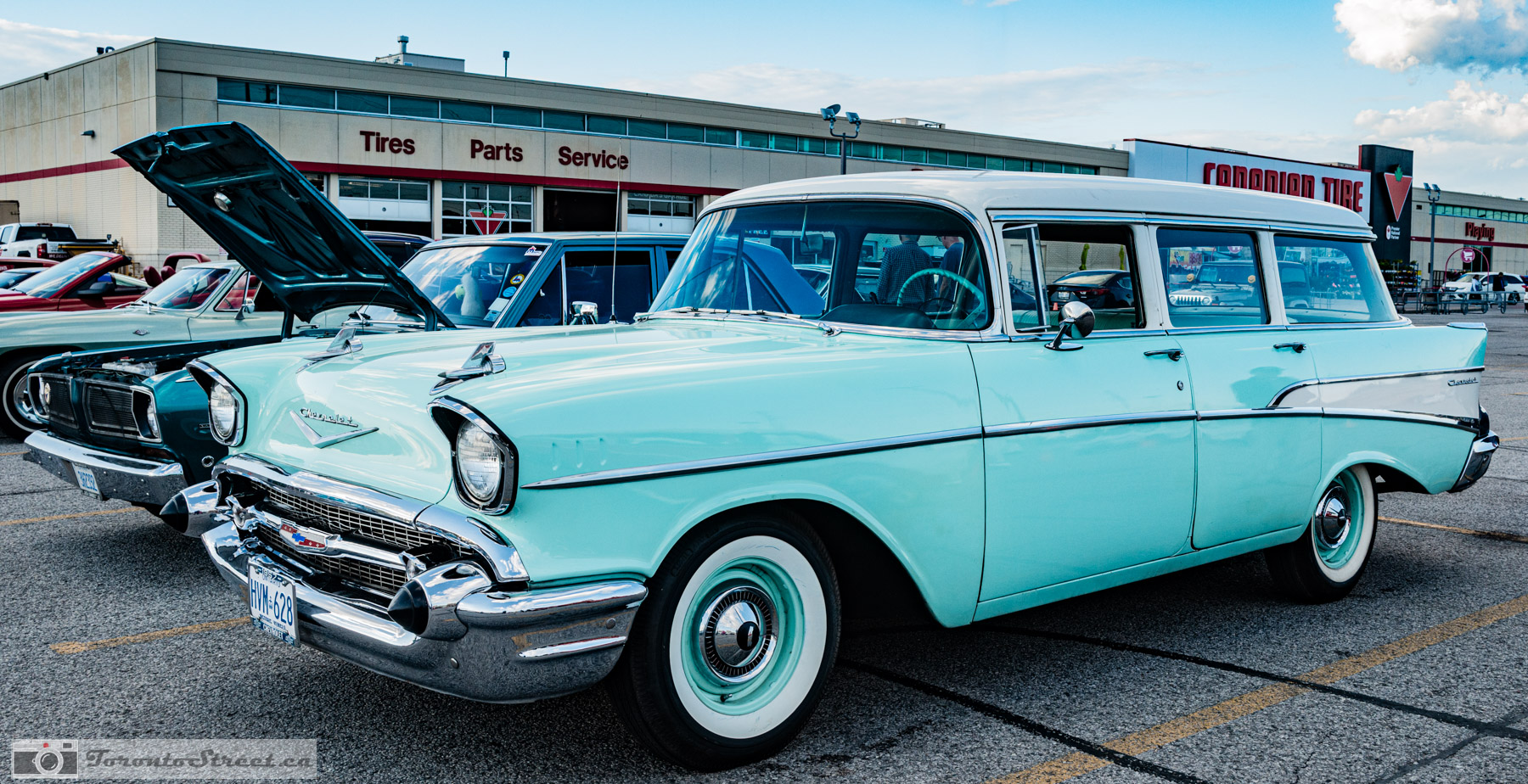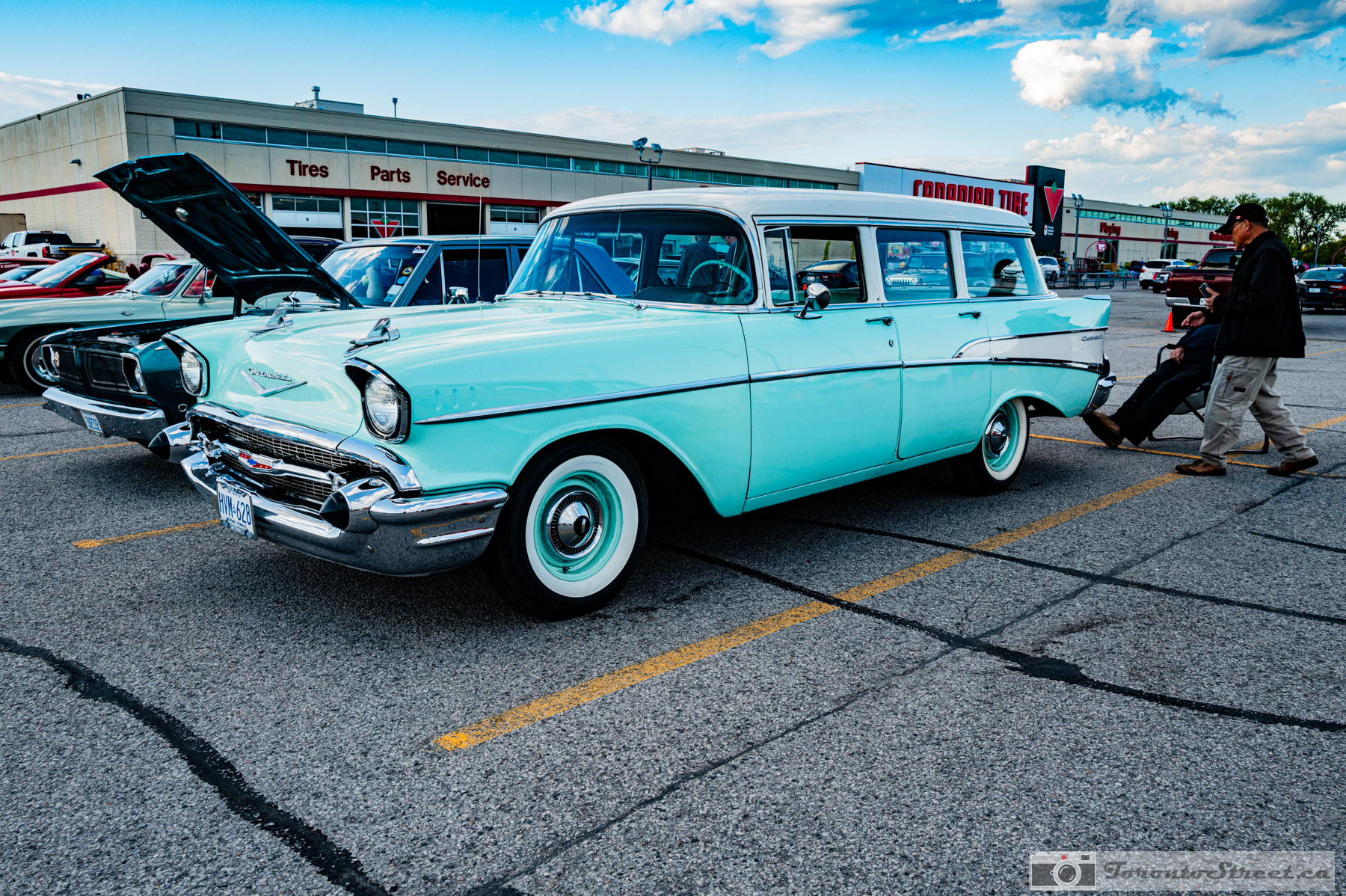
Tropical Turquoise and India Ivory, on a family wagon instead of a convertible. A 1957 Chevrolet Townsman, the four-door Two-Ten station wagon, parked in front of the Canadian Tire at the Monday night meet north of Toronto, the last Monday in May, with Tires, Parts, Service spelled out on the wall behind it. I photographed it at twenty past seven and then came back to it a quarter of an hour later, because the sky had changed. The wagon.
How You Know It Is a Two-Ten
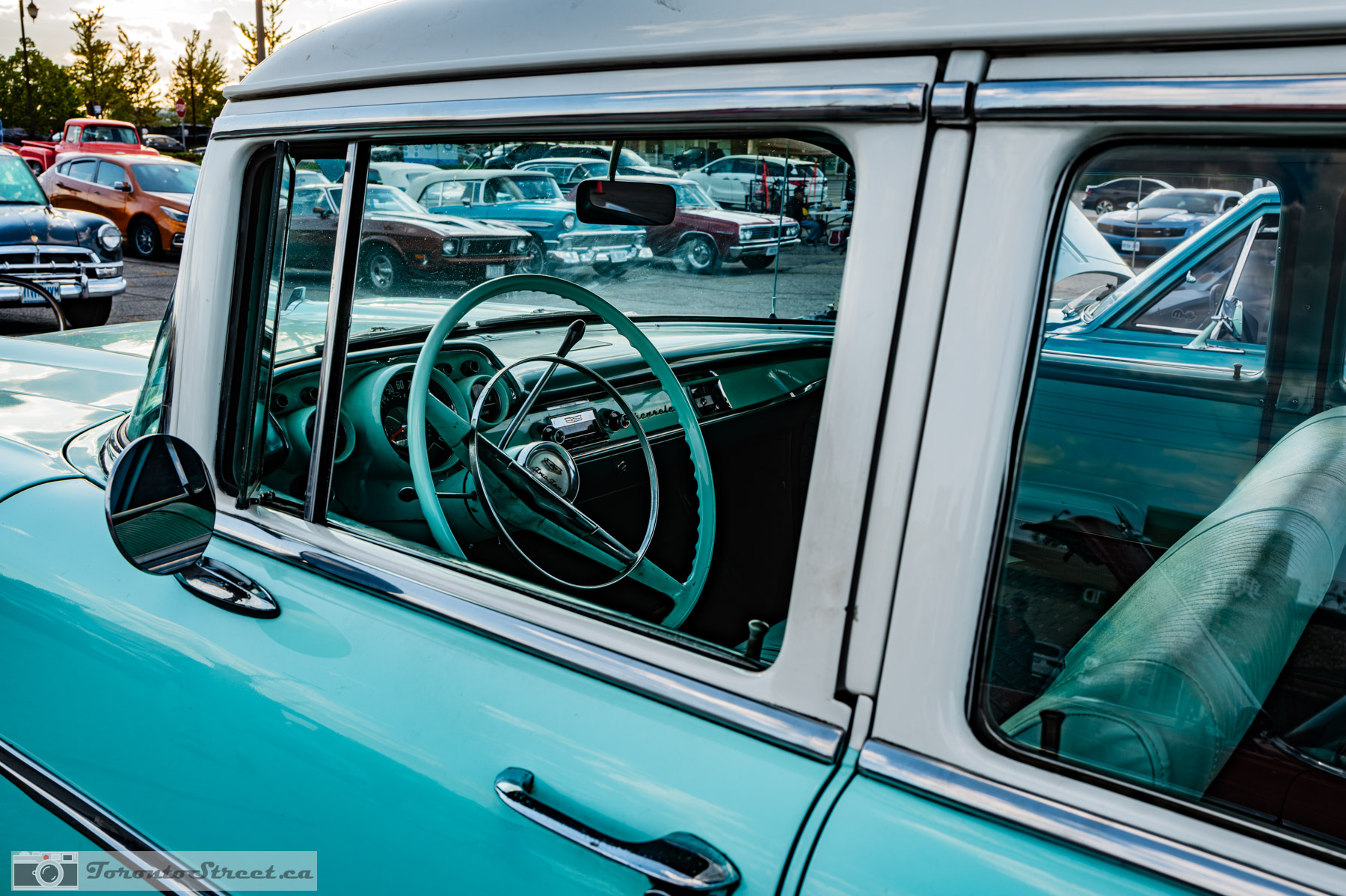
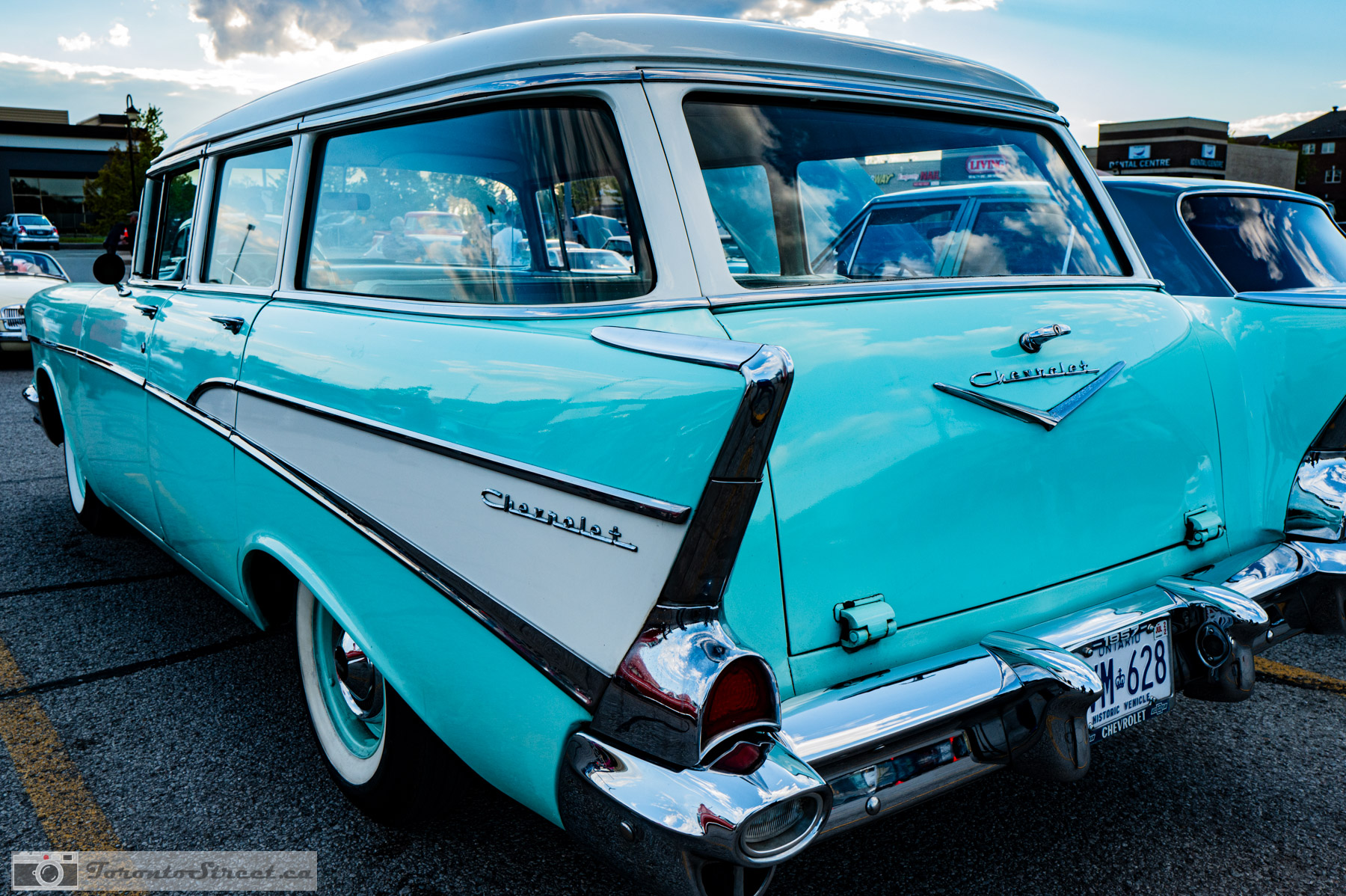
Everybody calls every 1957 Chevrolet a Bel Air, and a lot of the time they are wrong. The Bel Air was the top of the line, and the Two-Ten, the 210, sat one step under it. From the side they share the same trim, a long chrome spear and a wedge that sweeps back and up into the fin. On a Bel Air that wedge is filled with a ribbed aluminium panel. On a Two-Ten it is painted, here in the India Ivory of the roof, with Chevrolet in chrome script laid into it. The script and the V on the hood are chrome as well, where a Bel Air’s are gold. If you still have any doubt, look at the horn button through the driver’s window. It says Two-Ten.
That V on the hood means something too. In 1957 Chevrolet put it under the script on its V8 cars, and the six-cylinder cars went without. So this wagon has a V8, the 265 or one of the 283s. With the hood closed I could not tell you which.
Townsman was Chevrolet’s name for the four-door, six-passenger wagon, and for 1957 you could have one as a Two-Ten or as a Bel Air. The Two-Ten was by far the common one, about 129,000 of them against fewer than 28,000 Bel Air Townsman wagons, out of more than a million and a half Chevrolets built that year. The two-door Nomad gets the magazine covers. The Townsman carried the groceries, and most of them were used up doing it.
Tropical Turquoise on a 1957 Chevrolet Townsman
Tropical Turquoise for the body and India Ivory for the roof and the side panels were both Chevrolet colours for 1957, and together they are about as fifties as paint gets. The owner has carried the turquoise right down onto the wheels, painted to match, with small chrome centre caps instead of full wheel covers and wide whitewalls round them. Inside it keeps going, a turquoise dash with Chevrolet in script across it, a turquoise steering wheel with a chrome horn ring, and turquoise seats in the back.
From the back corner the fin and the ivory panel sweep up together into the taillight, the tailgate carries its own Chevrolet script and V, and the Ontario Historic Vehicle plate sits low in the bumper with a 1957 tag on the frame above it.
Twenty Past Seven, and Then the Clouds
The first frames are side-on and from the front corner, the whole length of the wagon with the Canadian Tire across the back of the frame and a dark green car with its hood up parked beside it. A man in a cap walked through one of them looking at his phone, not the car, and I kept it. That is a Monday night at these meets as much as the chrome is.
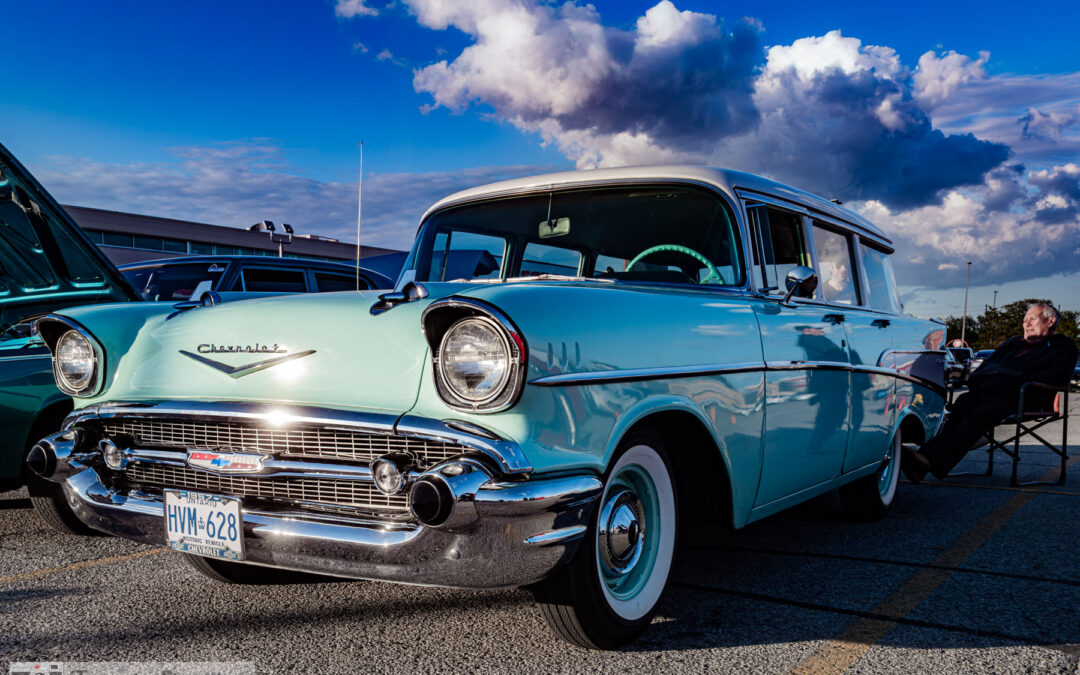
Then I went off down the rows, and spent some of that quarter of an hour at the back of a pink 1957 Lincoln Premiere a few cars over. When I came back the clouds had piled up over the lot and gone dark underneath, with the sun still on the car. I got down low at the front bumper and let the sky take the top half of the frame. A man in a folding chair beside the wagon was looking the other way.
Five frames of the 1957 Chevrolet Townsman on the Leica Q3, 28mm, f/8 and f/11 at 1/250, from twenty past seven to twenty-five to eight. Nothing on the car was touched or moved. Five years earlier the 210 was still called the Deluxe, and a 1952 Styleline Deluxe in Dusk Gray from the Monday night a week before is here. There are more cars from these Monday nights in my street photography projects.