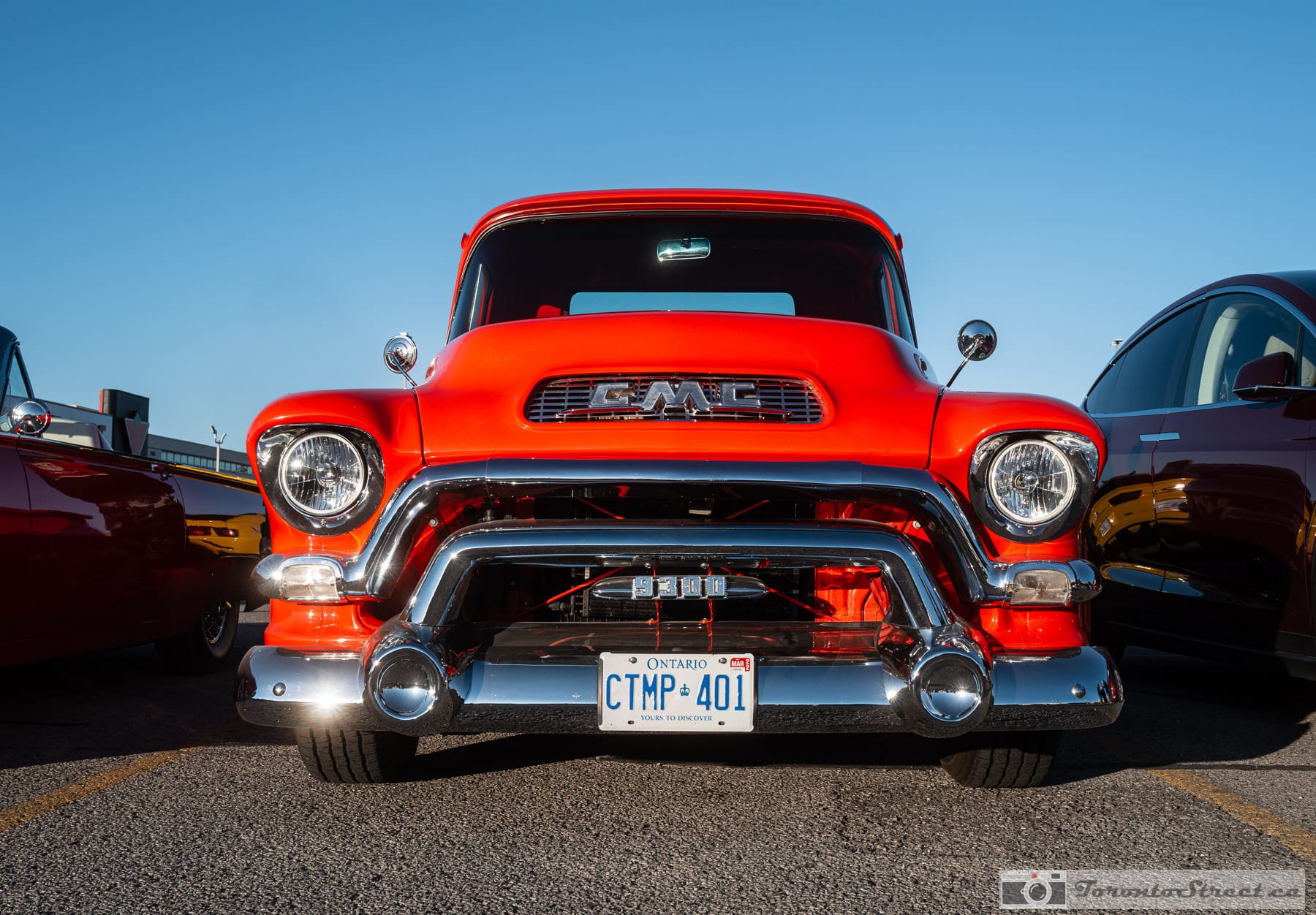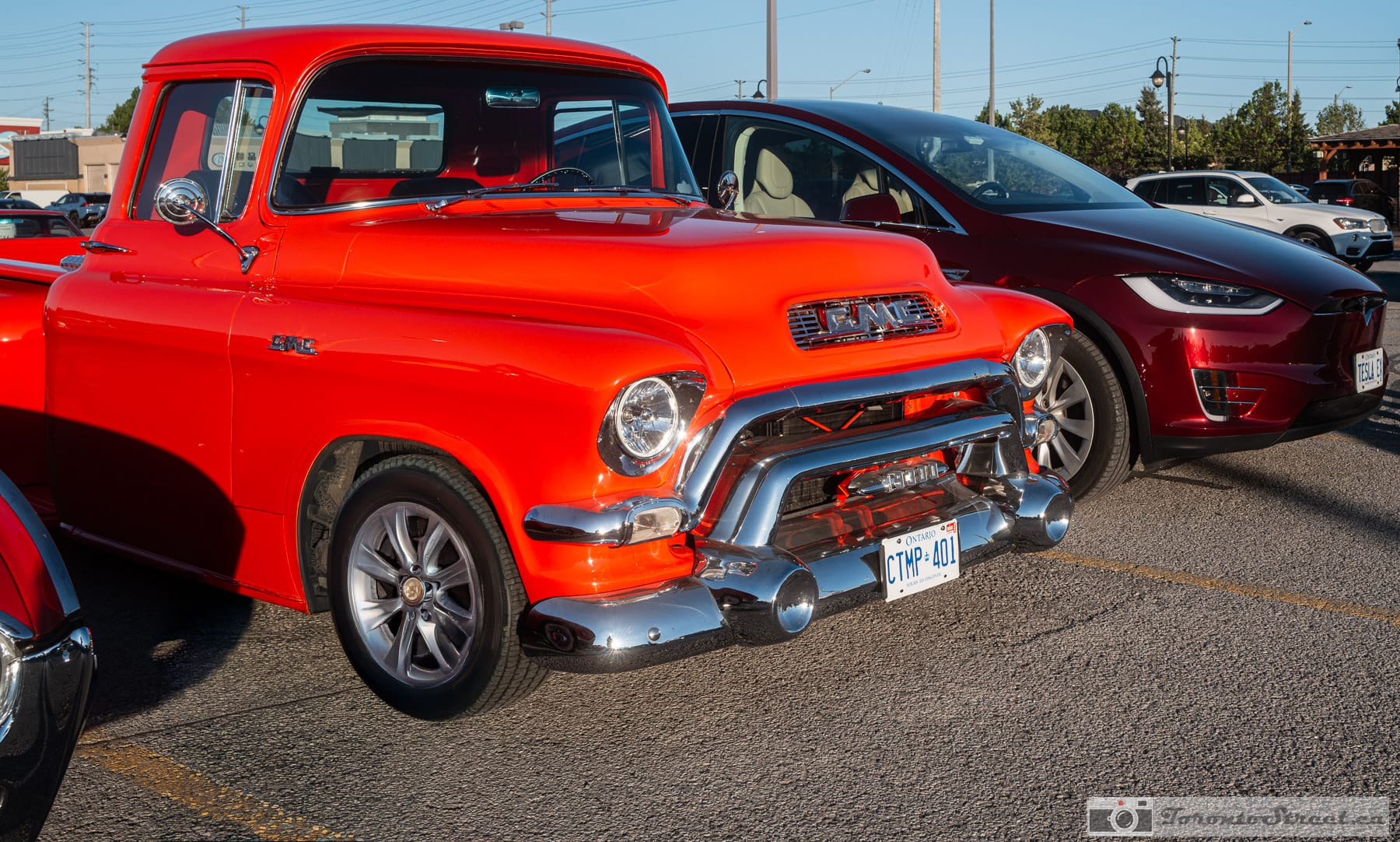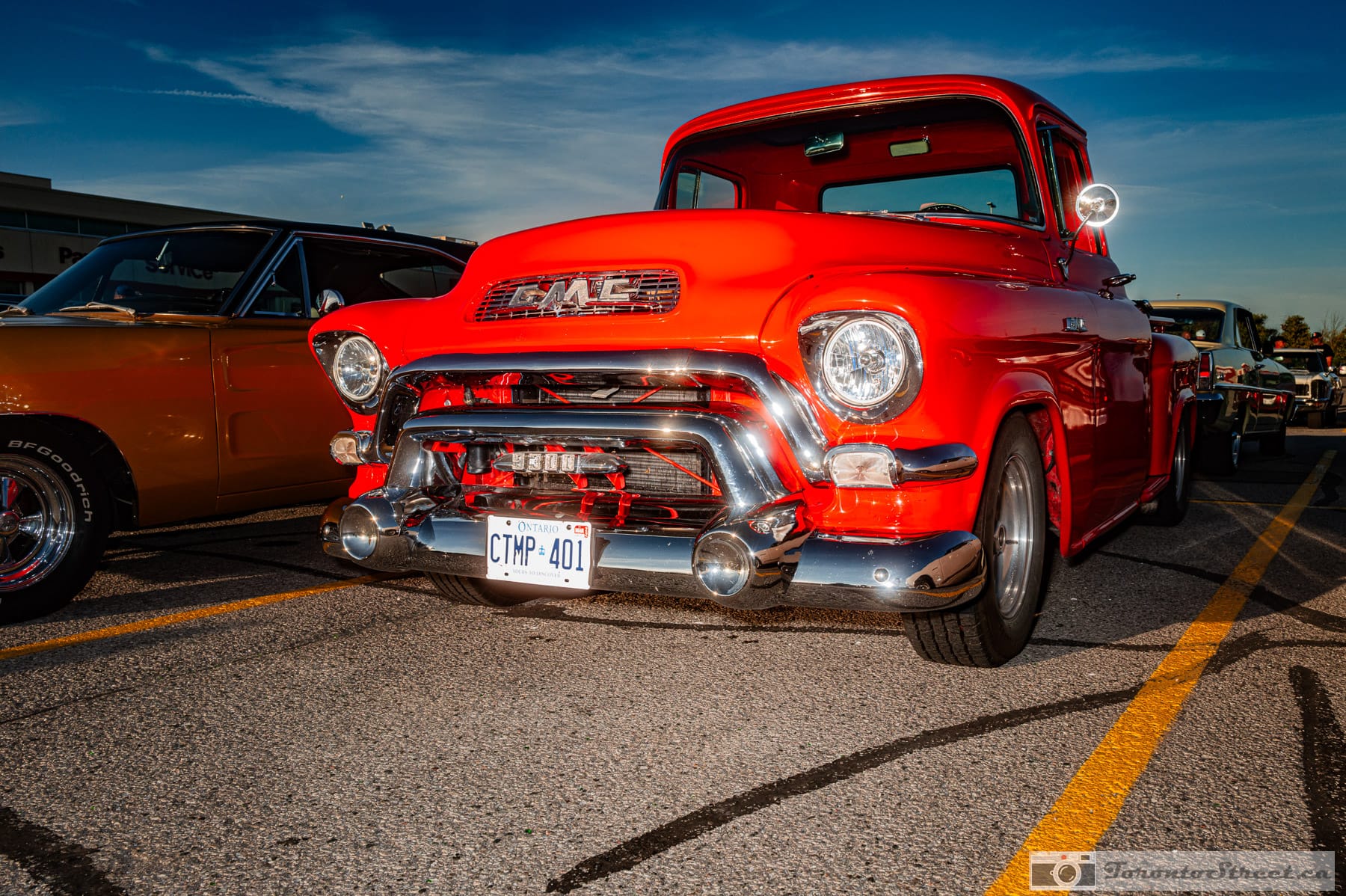
I did not find this one on a show field. It was sitting in a Canadian Tire parking lot on a Monday night in Richmond Hill, north of Toronto, a Tesla on one side and an orange Mopar on the other. That is my favourite kind of car show, the kind that is really just a cruise-in, where the cars roll in under their own power and park wherever there is room. The badge on the nose said something most people on this continent will never see in the metal. A 1957 GMC 9300 Stepside.
The Blue Chip Canada Built for Itself
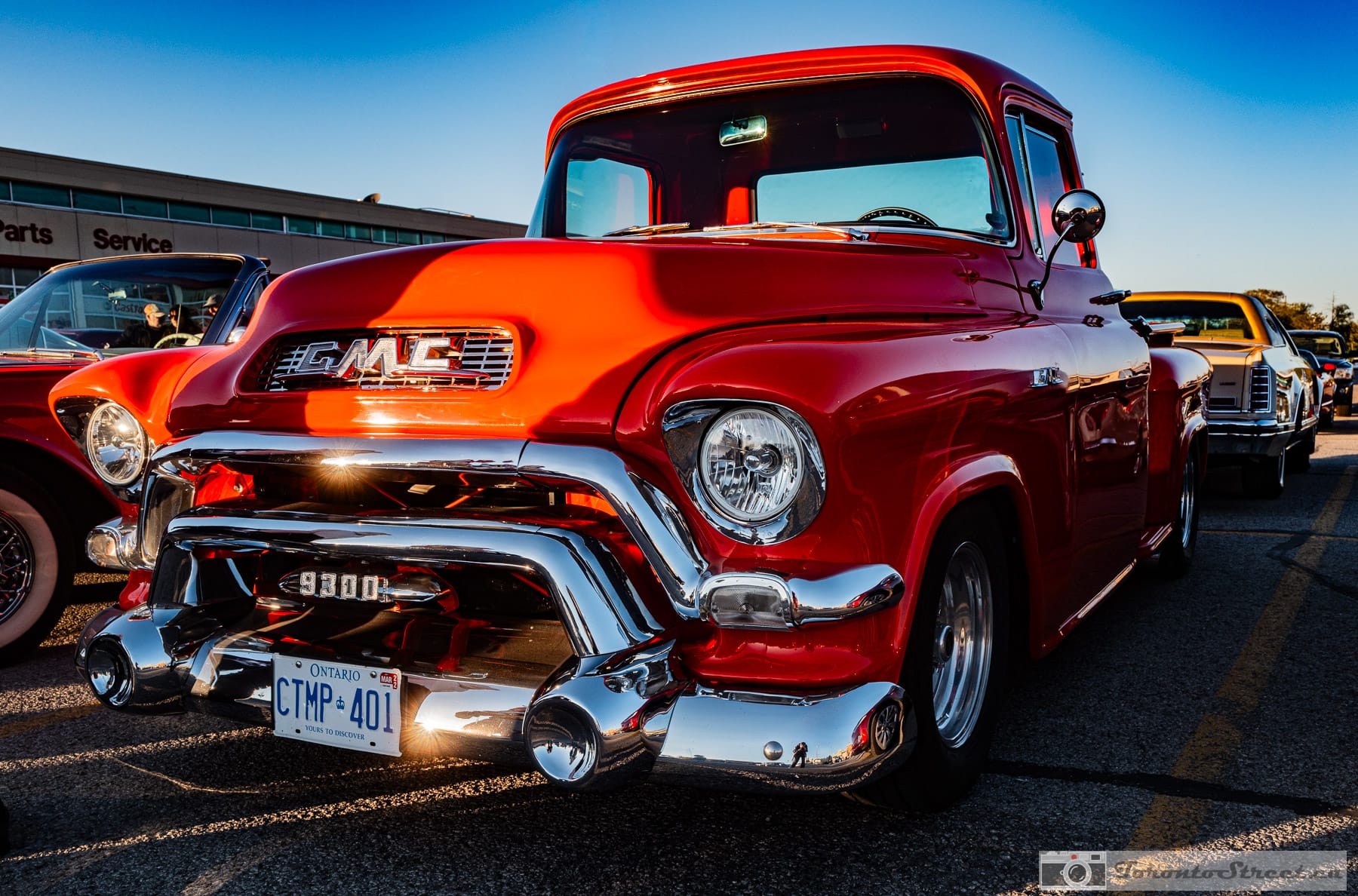
If you know these trucks you know the shape. This is GM’s Task Force generation, the 1955 to 1959 light-duty line that GMC dressed up and called the Blue Chip Series. South of the border it wore “100” on its flanks, the GMC cousin to Chevrolet’s 3100. This one was built by General Motors of Canada, and the Canadian plants gave it their own number, the 9300. Same Blue Chip styling, same bones, a different badge for a different market.
There is a nice wrinkle under the hood too. In the United States, GMC’s smaller trucks of this era ran Pontiac V8s. In Canada, GMC used Chevrolet engines instead. So a Canadian 9300 was, under its GMC skin, a Chevy-powered truck wearing a Pontiac-division badge. The GM family tree gets tangled in the best way up here.
What Makes It a 1957 GMC 9300 Stepside
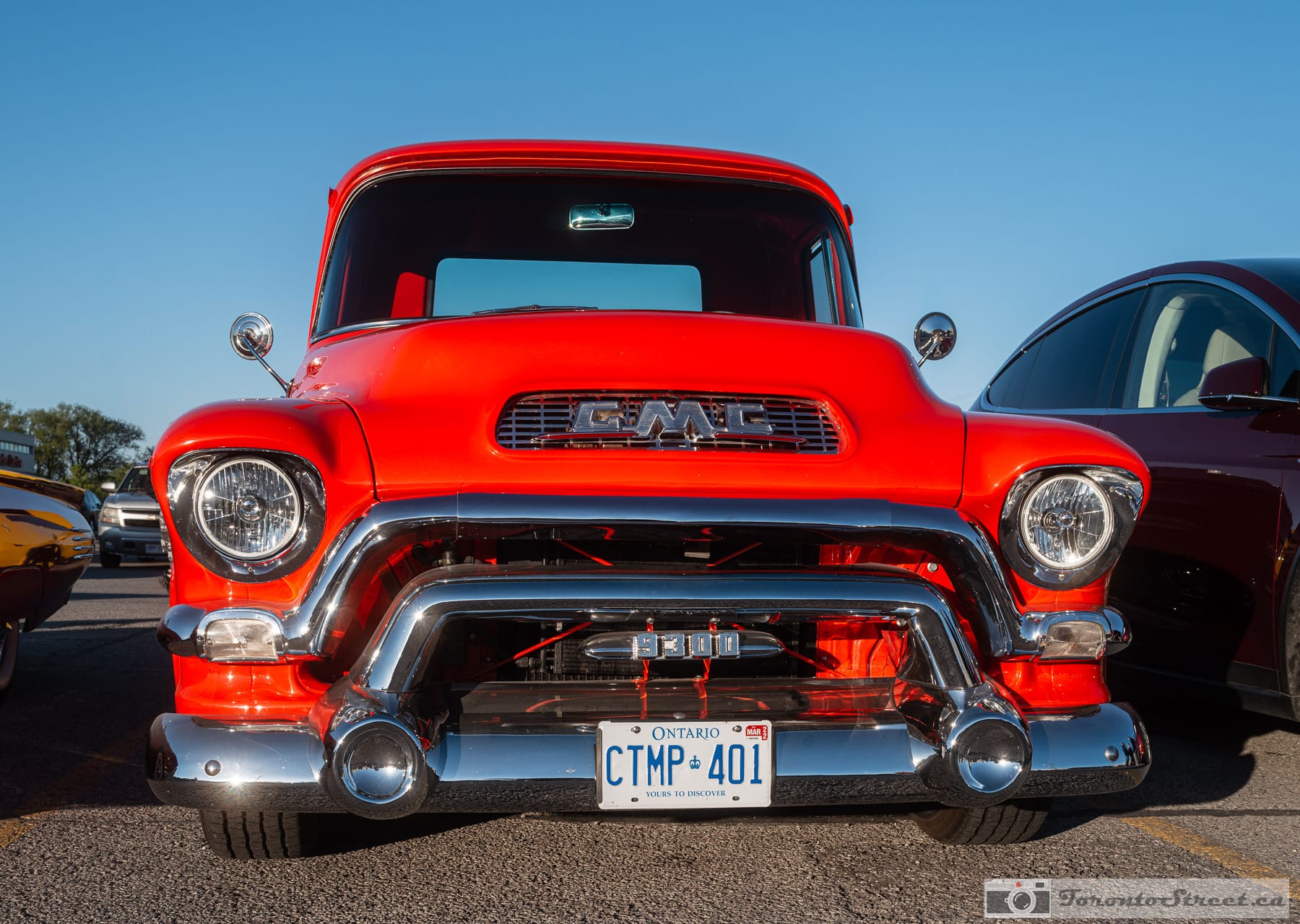
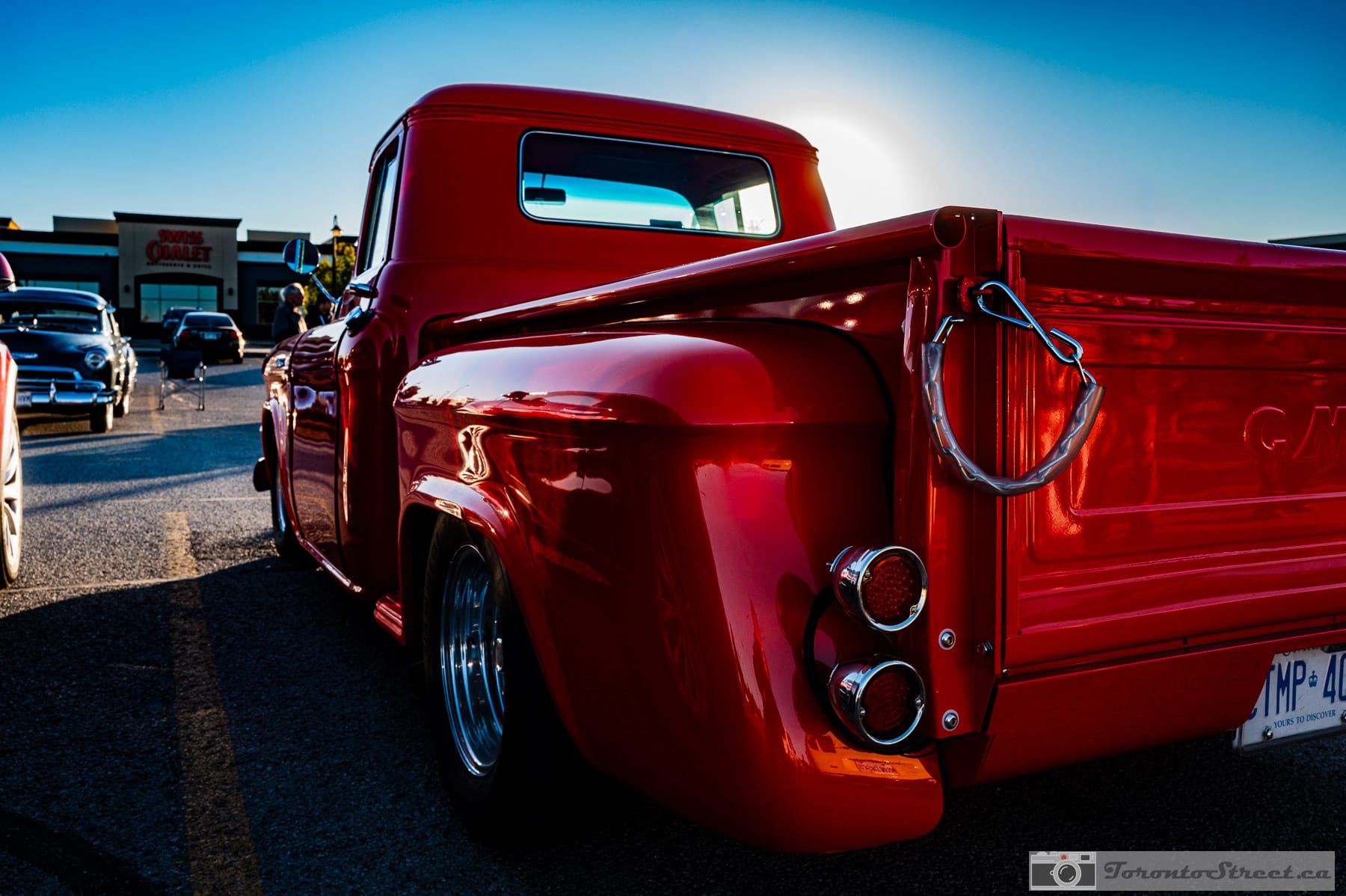
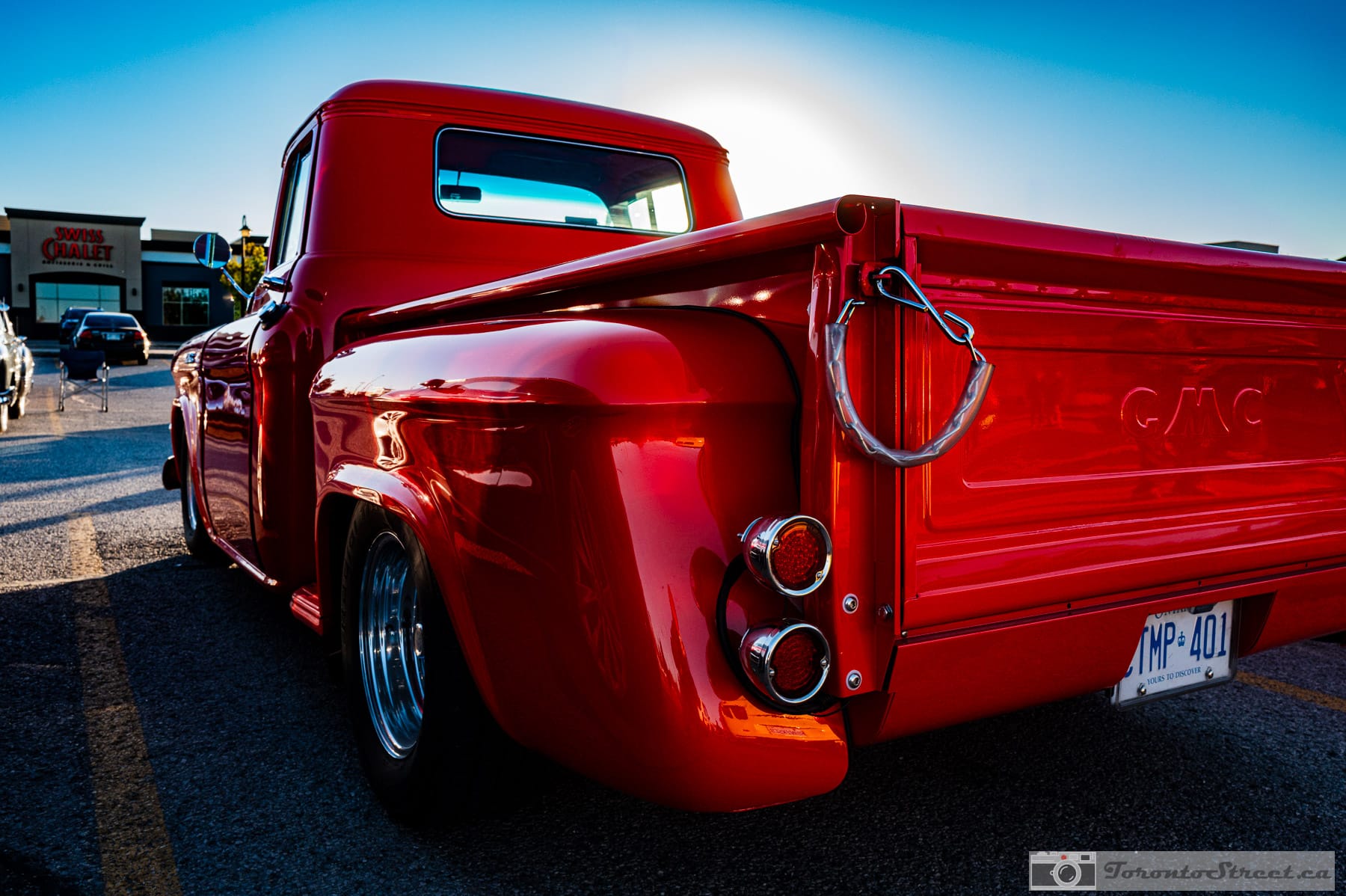
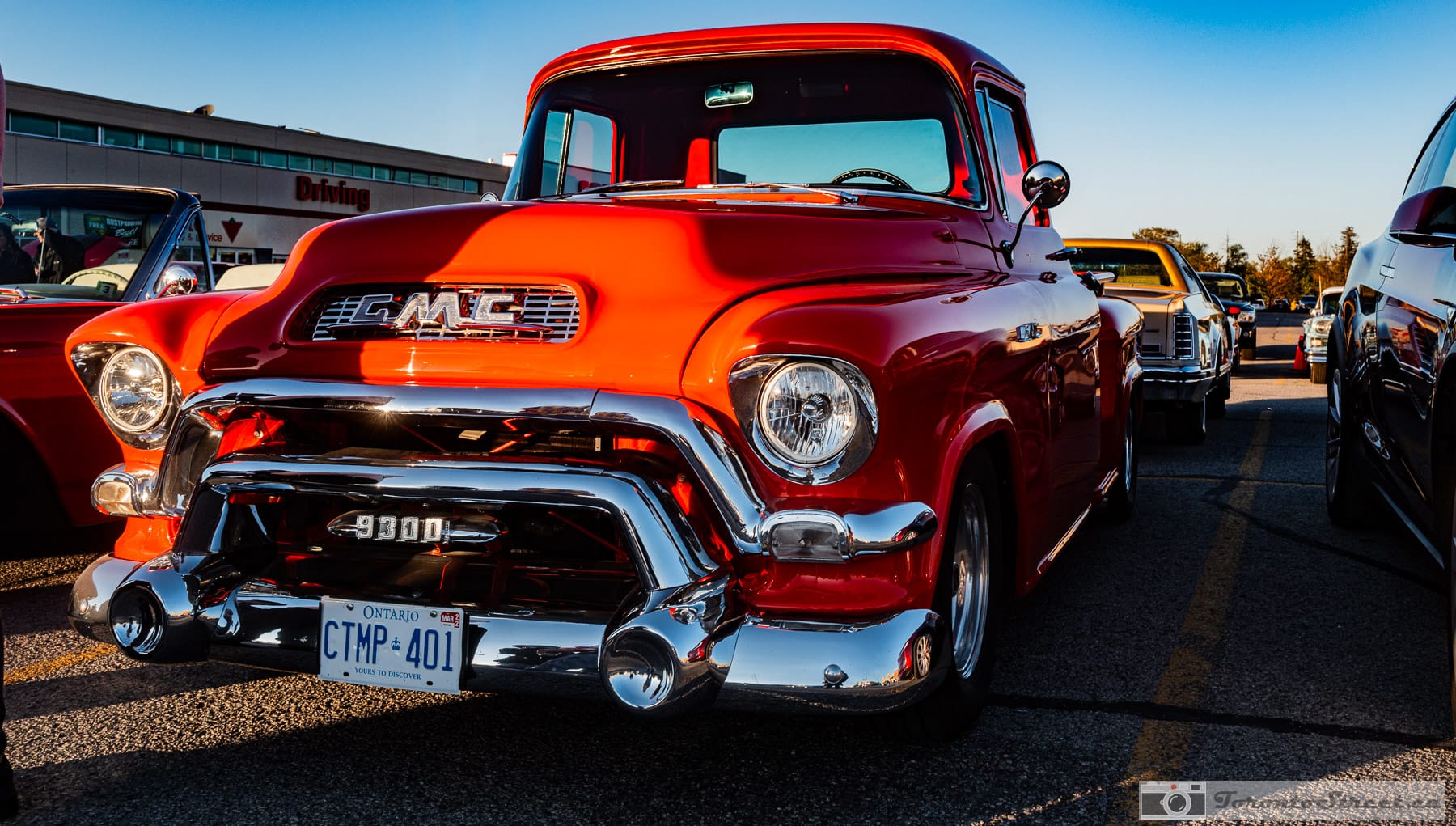
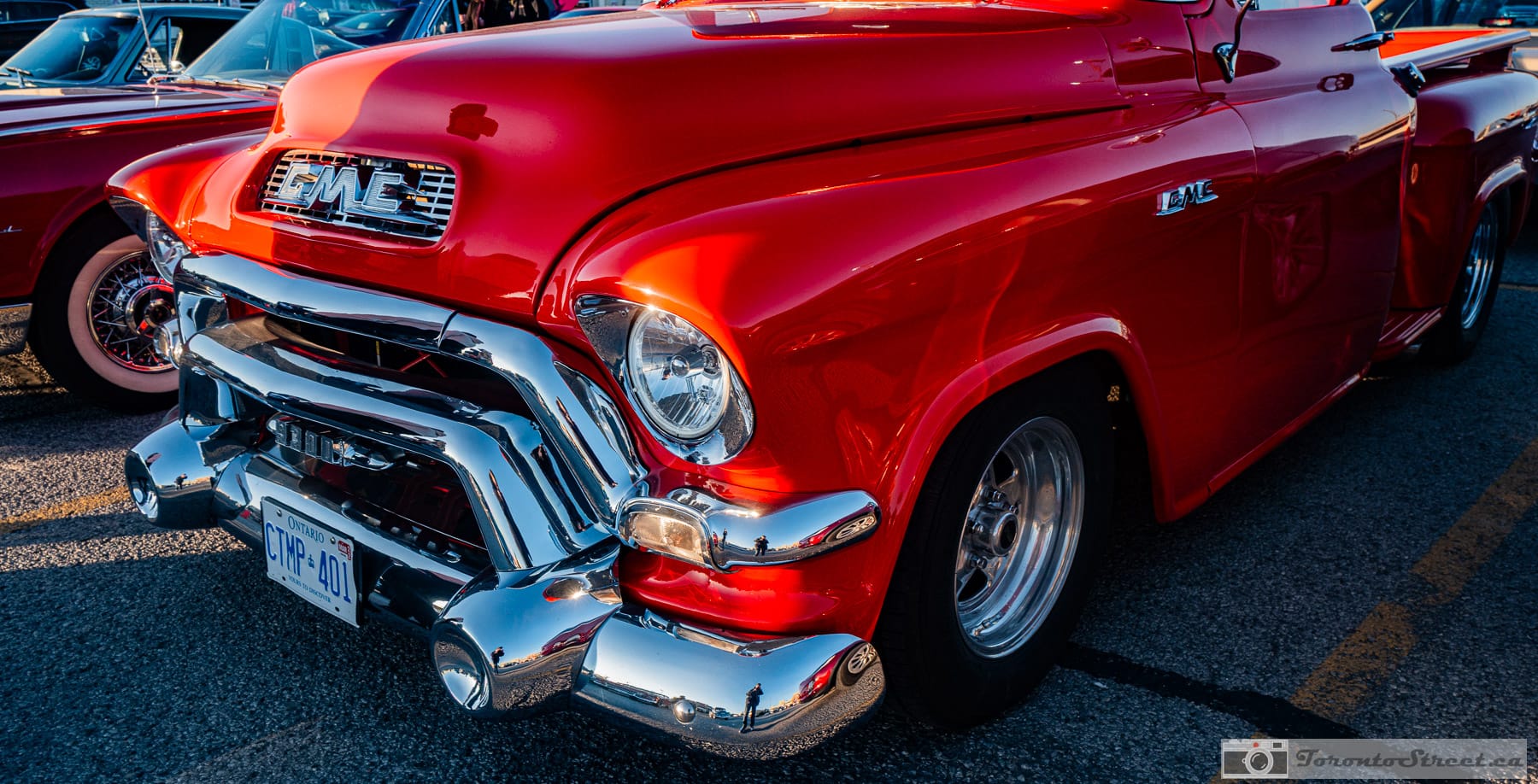
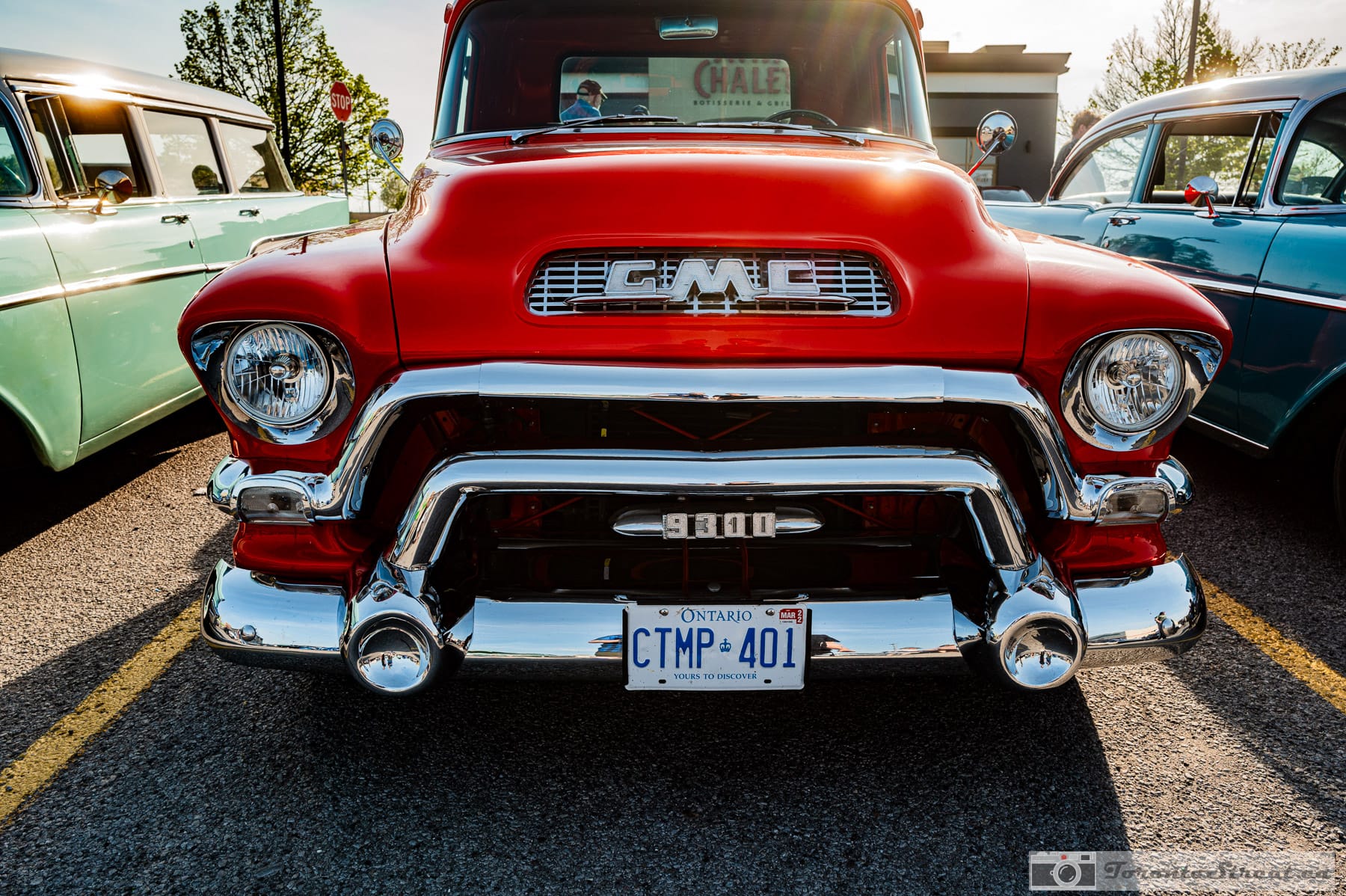
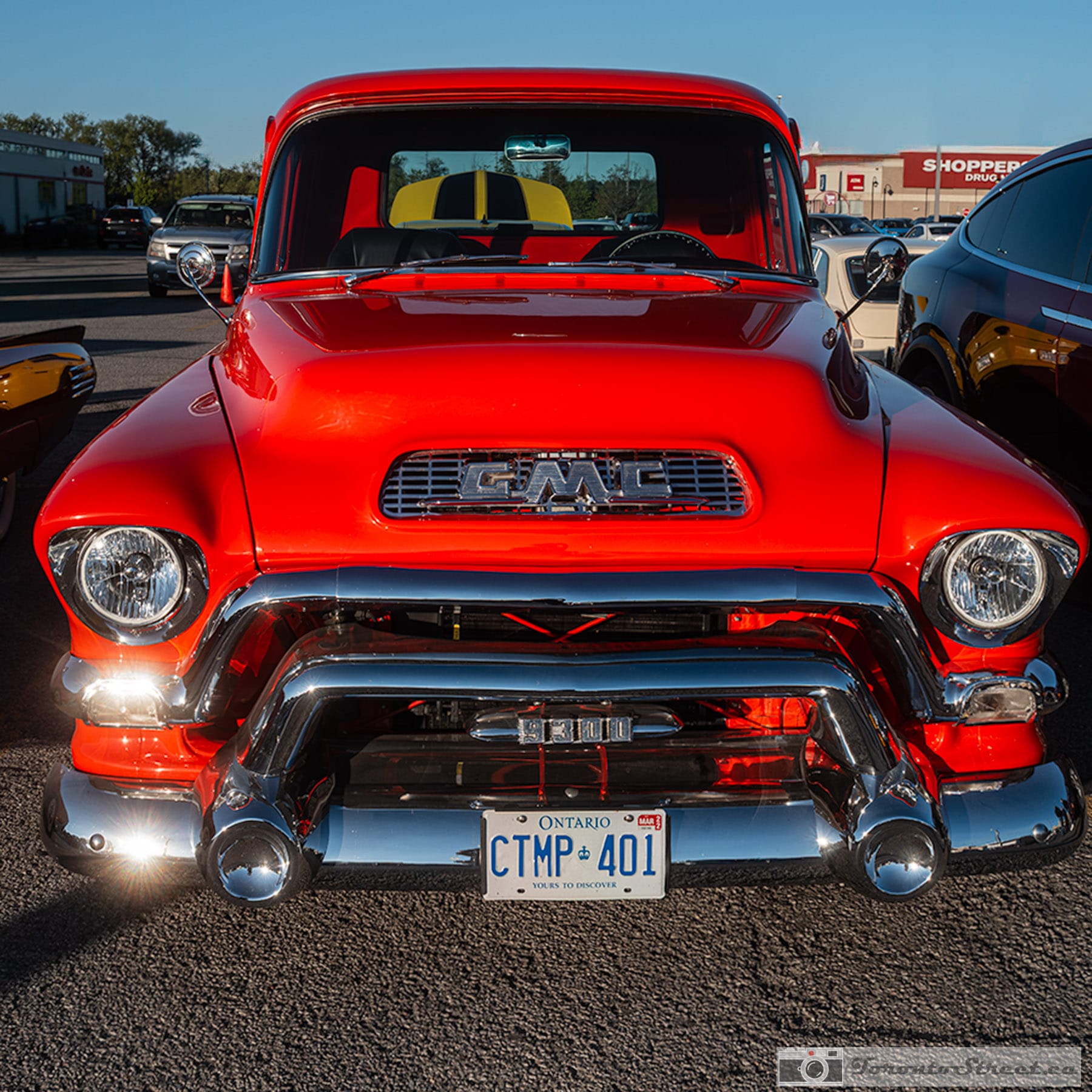
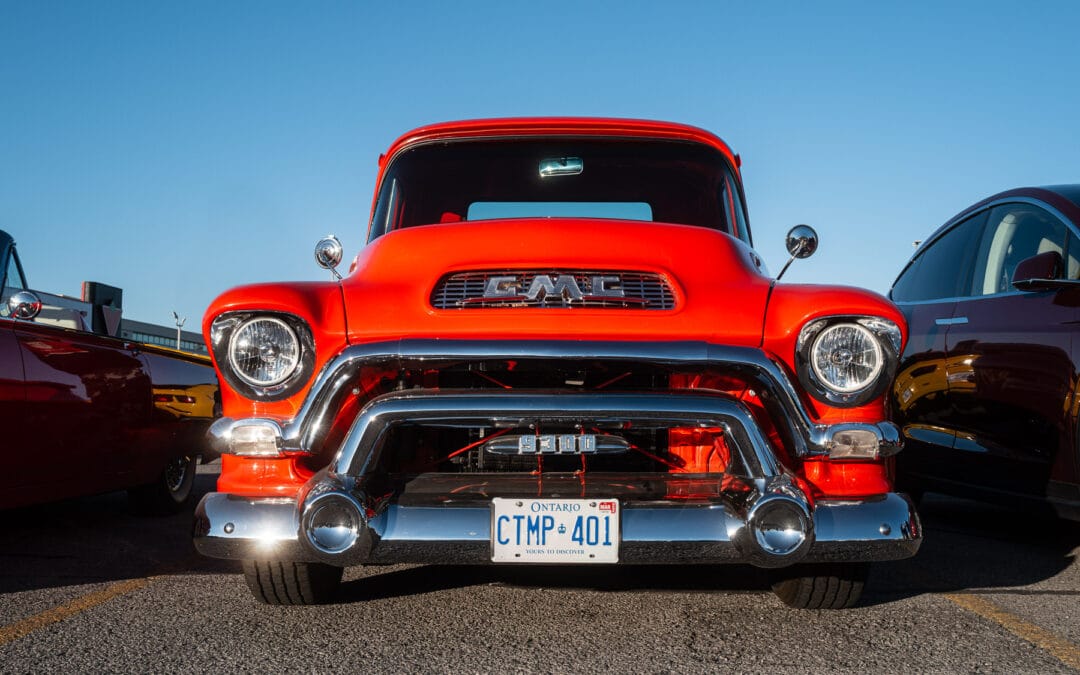
Dating it is easy once you know where to look. The 1957 grille is the showy one, a heavy three-piece chrome bar with GMC spelled out in block letters across the centre, flanked by neat rectangular parking lamps. The headlights are single and hooded, the last year before GM moved everyone to quad headlights for 1958, and the windshield does the full panoramic wraparound that made these cabs feel modern at the time. Around back is the Stepside bed, the narrow box with the curved rear fenders and the running boards stepped in ahead of them, the GMC logo stamped into the tailgate. That stepped-in bed is where the name comes from, and it dates and names this 1957 GMC 9300 Stepside as clearly as the grille does.
Not a Trailer Queen
I will be straight about what this is. It is not a preservation-class survivor, it is a built truck, a restomod or a street rod depending on which camp you sit in. The orange is a modern metallic, the taillights are bright dual LED units, the tailgate chains are sleeved in clear tubing so they do not chip the paint, and I would bet the original Canadian six gave way to something a lot newer a long time ago. Purists can argue all of that. Here is what I liked. It does not live on a trailer. It drove in, parked between an electric SUV and a Mopar, and looked completely at home doing it. That is the same reason I keep going back to these suburban cruise nights. A few weeks earlier, in the same lot, it was a 1966 Pontiac GTO convertible. You can see more of these nights in my street photography projects.
Chrome in the Last Good Light
I shot it in the last good light of the evening, which is when chrome like this earns its money. I work in available light with a Leica Q3 and its fixed 28mm lens, nothing added and nothing staged. I let the low sun run down the chrome bull bar and pool in the bumpers, then walked around and put the sun behind the bed so it rim-lit the fender, with a Swiss Chalet glowing in the background, which is about as Canadian a backdrop as a person could ask for. On a truck like this I expose for the highlights and let the shadows fall where they fall, because the whole point is the way the light sits on the chrome. If you want the camera details, they are on my gear page.
If the shape looks oddly familiar, there is a reason. A green Blue Chip 9300 is the truck Ty Borden drives on Heartland, which is probably the most screen time a Canadian 9300 will ever get. Not bad for a truck most of the continent has never heard of. I am sure some of you know far more about these than I do, and I would like to hear it. I just point the lens at whatever rolls in on a Monday night.